
I am a child of the space program, which is another way of saying I grew up believing that any problem on Earth could be solved if we just put enough men in white shirts, skinny black ties, and pocket protectors in a room with a chalkboard.
My parent woke me up at nearly 11 o’clock one night and said, “You need to see this.” That’s how I watched Neil Armstrong take his first steps on the moon. I was young enough to assume this sort of thing would continue regularly, like moon landings were scheduled right after the weather.
Then we stopped.
Now, as you read this, four astronauts should have already circled the moon and are headed back.
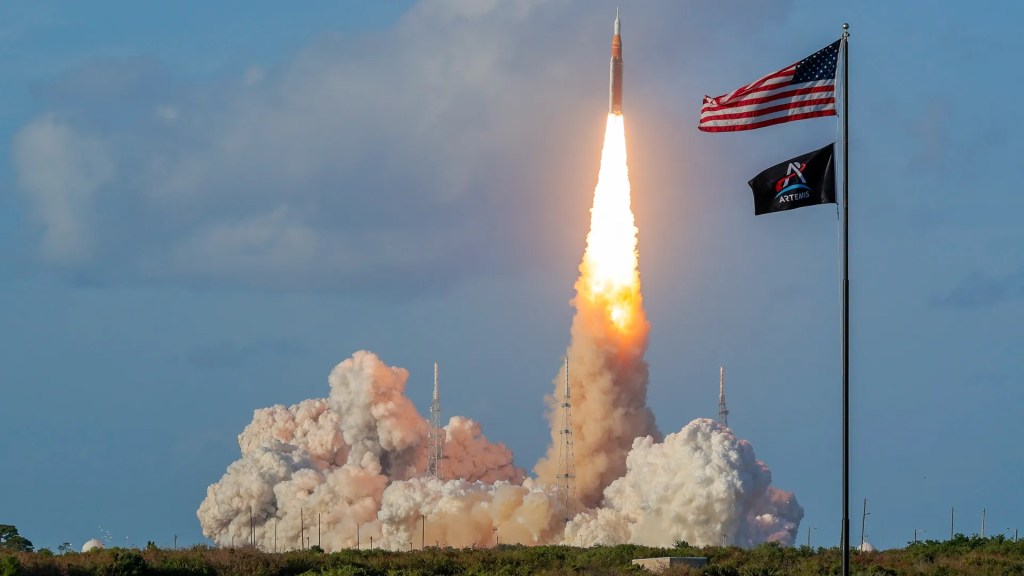
For the first time since 1972, human beings are going to the moon again. Not to land, mind you. Just to go up there, circle around, tip their helmets politely, and come home. It’s a 10-day trip designed to test life support systems and prove that we still know how to do something that once involved slide rules, duct tape, and courage that bordered on stubbornness.
NASA has been cautious, which is comforting. The rocket sat on the launchpad for a while before liftoff, as engineers double-checked and rechecked everything. If there’s one thing I’ve learned about rockets, it’s that you want them to be absolutely sure before lighting the fuse. This is not a crockpot situation. You don’t just shrug and say, “Let’s see what happens.”
Some people have asked, “Why are we going back to the moon?”
These are usually the same people who don’t understand why dogs stick their heads out car windows or why men insist on grilling in thunderstorms.
Because it’s there is still the correct answer.
Also, because we are humans, and humans explore. We wandered out of caves. We crossed oceans in boats that looked like lawn furniture. We climbed mountains for no practical purpose except to say, “I was up there.” Eventually, we were going to look back at the moon and say, “We ought to go check on that again.”
I’ve followed the space program all of my life. Part of that was helped along by a friendship with Sonny Carter, an astronaut from Macon. He loved flying and loved the idea that humans were meant to push outward, not just sit still and complain about the price of gas.
Sonny would have loved this mission.
There’s something beautifully unreasonable about spaceflight. You strap people to a controlled explosion, point them at the sky, and trust that math, physics, and teamwork will do the rest. You accept that something could go wrong, and you go anyway.
We don’t need the moon to survive. We need it to remind ourselves who we are.
We need reminders that we are capable of doing big, ridiculous, beautiful things simply because they are hard. We need moments when we look up and say, “We’ve been there,” and then immediately start planning how to do it better.
Somewhere tonight, a kid will look up at the moon, realize that humans are passing by again and feel something click into place.
That’s how it starts.
Here’s hoping the mission continues smoothly, the systems do what they’re supposed to do, and the astronauts come home safe, splashing down in the Pacific like punctuation at the end of a very long sentence.
And here’s hoping some parent wakes a child late at night and says, “You need to see this.”
Because that’s how explorers are made.

